Quantum Computing Explained: A Complete Beginner's Guide (2026)
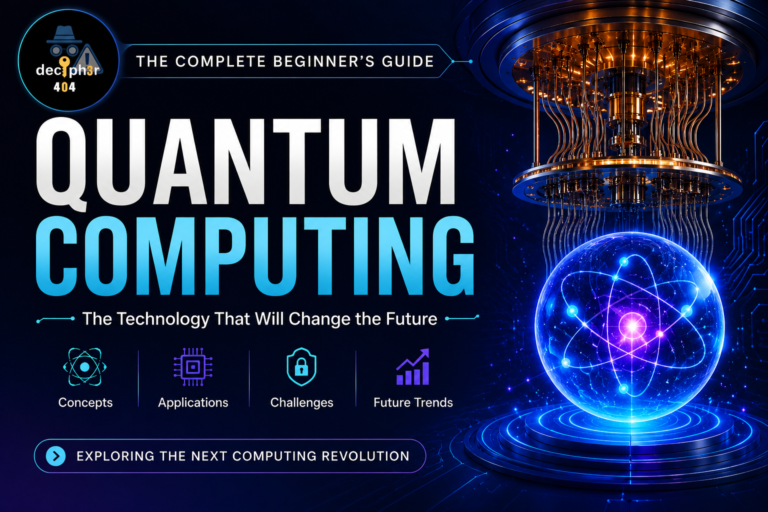
Quantum computers are among the most exciting technologies being developed today. Unlike traditional computers that process information using bits, quantum computers use qubits and the principles of quantum mechanics to solve certain problems in entirely new ways.
In this guide, you’ll learn what quantum computers are, how they work, why they matter, and what the future of quantum computing could look like.
Table of Contents:
What Are Quantum Computers?
Imagine trying to solve a maze.
A quantum computer behaves differently. It can explore many possible paths simultaneously using the strange laws of quantum physics. That’s why quantum computers are considered one of the most revolutionary technologies of the 21st century.
At their core, quantum computers are machines that process information using qubits instead of traditional binary bits.
Classical computers use:
- 0
- 1
Quantum computers use:
- 0
- 1
- Both at the Same time
That single difference changes everything.
Why Quantum Computing Matters
Quantum computing matters because some problems are simply too massive for even the world’s fastest supercomputers.
Examples include:
- Discovering new medicines
- Simulating molecules
- Predicting climate systems
- Optimizing global logistics
- Breaking complex encryption
- Accelerating artificial intelligence
A powerful quantum computer could potentially solve in minutes what would take traditional computers thousands of years. That’s why governments, tech giants, and startups are investing billions into quantum research.
The Fascinating History of Quantum Computing
Early Foundaions
In the early 1900s, scientists discovered that particles behave strangely at microscopic scales. This led to quantum mechanics.
Famous physicists like Albert Einstein. Niels Bohr, Richard Feynman helped build the foundation.
The Big Idea
In 1981, Richard Feynman suggested something radical: ” Nature itself is quantum, so maybe computers should be quantum too. “
Major Milestones
- 1994: Peter Shor develops Shor’s Algorithm
- 2011: First commercial quantum systems appear
- 2019: Google claims “quantum supremacy”
- 2020s: Quantum race accelerates globally
Today, quantum computing is moving from theory into reality.
How Quantum Computers Work
Quantum computers operate using principles from quantum mechanics.
The three most important concepts are:
- Qubits
- Superposition
- Entanglement
Together, these create computational power unlike anything we’ve seen before.
What Are Qubits?
A classical computer stores information in bits.
A bit is either:
- 0
- 1
A qubit is different. It can exist in multiple states simultaneously.
Think of a spinning coin:
- Heads = 0
- Tails = 1
- Spinning = both possibilities at once
That spinning state is what gives quantum computers their power.
Superposition Explained Simply
Superposition allows qubits to represent multiple possibilities simultaneously.
Imagine searching for a friend in a massive library.A normal computer checks every room one by one. A quantum computer can explore many rooms simultaneously. That doesn’t mean it magically knows the answer instantly, but it dramatically increases computational efficiency for certain problems.
Entanglement Explained Simply
Entanglement is even stranger. When two qubits become entangled, changing one instantly affects the other — even across large distances.
Einstein famously called this: “Spooky action at a distance.”
Entanglement enables quantum systems to coordinate information in powerful ways impossible in classical systems.
Quantum Computers vs Classical Computers
| Feature | Classical Computers | Quantum Computers |
|---|---|---|
|
Basic Unit |
Bit |
Qubit |
|
States |
0 or 1 |
0 and 1 simultaneously |
|
Processing Style |
Sequential |
Parallel quantum states |
|
Strength |
Everyday tasks |
Complex optimization/simulation |
|
Best For |
Browsing, gaming, office work |
Scientific research, cryptography |
|
Stability |
Highly stable |
Extremely fragile |
|
Availability |
Widely available |
Experimental |
Real-World Applications of Quantum Computing
DRUG DISCOVERY
Quantum computers could simulate molecules with incredible precision. This may accelerate:
- Cancer treatments
- Vaccine development
- Protein folding research
ARTIFICIAL INTELLIGENCE
AI models require massive optimization. Quantum systems may:
- Train models faster
- Improve pattern recognition
- Optimize neural networks
FINANCIAL MODELING
Banks use quantum algorithms for:
- Risk analysis
- Fraud detection
- Portfolio optimization
LOGISTICS & SUPPLY CHAINS
Companies can optimize:
- Delivery routes
- Warehouse operations
- Traffic systems
- Airline scheduling
CLIMATE RESEARCH
Quantum simulations may improve:
- Weather forecasting
- Carbon capture research
- Energy optimization
Quantum Computing in AI
Quantum AI is becoming one of the hottest topics in technology. The idea is simple: Combine AI with quantum processing power.
Potential benefits include:
- Faster machine learning
- Better optimization
- Enhanced data analysis
- Smarter automation
Major players exploring Quantum AI include:
- IBM
- Microsoft
- NVIDIA
Many experts believe quantum AI could trigger the next massive leap in artificial intelligence.
Quantum Computing and Cybersecurity
Here’s where things become controversial.
Modern encryption protects:
- Banking systems
- Government data
- Passwords
- Cryptocurrency wallets
But powerful quantum computers may eventually break current encryption methods.
This is why “post-quantum cryptography” is becoming a major cybersecurity priority. Governments worldwide are preparing for a future where traditional encryption may become obsolete.
Industries Already Using Quantum Computing
HEALTHCARE
- Drug simulation
- Genomics research
- Precision medicine
AUTOMOTIVE
- Autonomous driving optimization
- Battery research
FINANCE
- Market prediction
- Portfolio balancing
AEROSPACE
- Material science
- Flight optimization
ENERGY
- Nuclear simulation
- Smart grids
TELECOMMUNICATIONS
- Network optimization
- Quantum communication
Top Companies Building Quantum Computers
IBM : IBM offers cloud-based quantum systems and has become a leader in enterprise quantum computing.
Google: Google’s Quantum AI division achieved global attention with its quantum supremacy announcement.
Microsoft : Microsoft focuses heavily on scalable quantum architectures and quantum development tools.
Intel : Intel is developing quantum chips using semiconductor expertise.
D-Wave : D-Wave specializes in quantum annealing systems.
Rigetti Computing : Rigetti focuses on hybrid quantum-classical computing.
Current Limitations and Challenges
Quantum computing is powerful — but still immature.
- Error Rates – Qubits are incredibly fragile and Tiny environmental disturbances can destroy calculations.
- Cooling Requirements – Many quantum systems operate near absolute zero temperatures, that requires expensive infrastructure.
- Scalability – Building stable systems with millions of qubits remains extremely difficult.
- Cost- Quantum hardware is extraordinarily expensive.
- Software Complexity- Quantum programming requires advanced mathematics and physics knowledge.
Quantum Computing Myths Debunked
Myth 1: Quantum Computers Will Replace Laptops
- Quantum computers are specialized machines.
- Classical computers will still dominate everyday tasks.
Myth 2: Quantum Computers Are Unlimited
- Quantum systems excel only at certain types of problems.
Myth 3: Quantum Computing Is Pure Hype
- Major breakthroughs are already happening.
- The technology is real — but still developing.
Beginner Mistakes When Learning Quantum Computing
Ignoring Classical Computing
- Quantum computing builds on classical computing concepts.
Focusing Only on Theory
- Use simulators and practical tools early.
Expecting Instant Understanding
- Quantum concepts are intentionally non-intuitive.
- Confusion is normal initially.
The Future of Quantum Computing
Many experts believe the next decade could redefine computing forever.
Future possibilities include:
- Quantum internet
- Ultra-secure communication
- Revolutionary AI systems
- New materials discovery
- Breakthrough medical research
- Massive energy optimization
Some predictions may take decades. Others may arrive surprisingly fast.
One thing is clear: Quantum computing is no longer science fiction. It’s an emerging technological revolution.
How Beginners Can Learn Quantum Computing
Learn the Basics of Quantum Mechanics:
Focus on:
- Superposition
- Entanglement
- Probability
Learn Python
- Python is widely used in quantum development.
Explore Quantum Frameworks
Popular platforms include:
- Qiskit
- Cirq
- PennyLane
Use Free Quantum Simulators
- Several companies provide cloud quantum tools.
Take Online Courses
Look for:
- Beginner quantum computing courses
- Quantum programming tutorials
- Quantum algorithm introductions
People Also Ask
Can quantum computers break Bitcoin?
Potentially in the future, though current quantum computers are not powerful enough yet.
Are quantum computers faster than supercomputers?
For certain problems, yes. For general tasks, not necessarily.
Who invented quantum computing?
Multiple scientists contributed, but Richard Feynman played a major role in popularizing the idea.
How expensive is a quantum computer?
Advanced systems can cost millions of dollars.
Can I learn quantum computing without physics?
Yes, although understanding basic quantum mechanics helps significantly.
FAQ Section
What is a quantum computer in simple words?
A quantum computer is a machine that uses quantum physics principles to process information much faster for certain complex problems.
What are qubits?
Qubits are the basic units of information in quantum computing. Unlike normal bits, they can exist in multiple states simultaneously.
Why is quantum computing important?
Quantum computing could revolutionize medicine, AI, cybersecurity, logistics, and scientific research.
Are quantum computers available today?
Yes, but they are still experimental and mostly used by researchers and large companies.
Will quantum computers replace classical computers?
No. They are designed for specialized tasks rather than everyday computing.
Conclusion
Quantum computing represents one of humanity’s boldest technological frontiers.
Right now, we’re standing at a moment similar to the early internet era:
- The technology is difficult
- The infrastructure is immature
- The possibilities are enormous
For beginners, students, developers, and tech enthusiasts, understanding quantum computing today could become incredibly valuable tomorrow.
The next generation of breakthroughs in:
- AI
- Medicine
- Cybersecurity
- Climate science
- Space exploration
The quantum era has already begun.
🔗 Stay Connected for Latest Updates!
New blog posts are published every week covering topics such as web development, Linux commands, cybersecurity, software installations, and top AI tools for 2025. Each update delivers practical insights, tutorials, and tips to stay informed in the fast-evolving world of technology. Stay tuned for consistent and valuable tech content.
📢 Follow me on social media to get notified about new blog posts, exciting updates, and more!