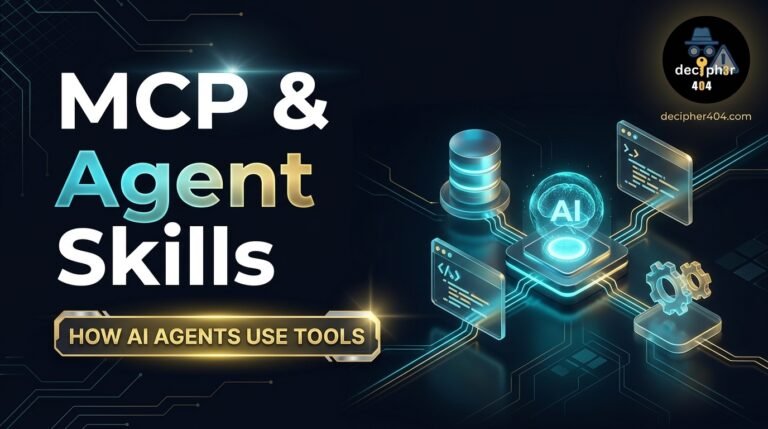
Artificial intelligence is moving beyond chatbots that simply answer questions. A newer generation of AI systems can interact with external tools, retrieve information, follow workflows, and help complete multi-step tasks. These systems are commonly called AI agents.
But an AI model alone cannot do everything. To work with real applications and services, an agent needs a way to connect to tools. It also needs instructions that explain how to use those tools correctly.
Two technologies gaining attention in this area are the Model Context Protocol (MCP) and Agent Skills. They address different parts of the same challenge: helping AI agents connect to external systems and perform useful work in a more structured way.
In this guide, we’ll explain what MCP and Agent Skills are, how they work together, and why they matter for the future of AI.
An AI agent is a system that uses an AI model to work toward a goal. Unlike a basic chatbot that responds to a single prompt, an agent can break a task into smaller steps, choose tools, use information from external sources, and adjust its approach based on the results.
For example, imagine asking an AI assistant to prepare a weekly sales report. Depending on its permissions and integrations, an agent might:
1. Retrieve sales data from a connected database.
2. Organise the information into useful categories.
3. Calculate totals and identify trends.Generate a summary.
4. Create a report for a human to review.
5. It can use connected tools to carry out parts of the workflow.
The important distinction is that the agent is not merely describing how to do the work.
However, this requires more than a capable language model. The agent needs reliable access to data, clearly defined actions, and instructions for completing the task.
The Model Context Protocol (MCP) is an open protocol that provides a standardised way for AI applications to connect with external tools and data sources.
Without a common protocol, developers may need to build separate integrations for different AI applications and services. This can make projects difficult to maintain as the number of tools and platforms grows.
MCP helps address this integration challenge by providing a shared communication approach.
An MCP-based setup commonly involves:
For example, a developer could connect an AI application to an MCP server that exposes approved database operations. The agent can then discover and use those operations instead of relying only on information included in its original prompt.
MCP does not make an AI model intelligent by itself. It provides a structured way for an AI application to interact with external capabilities.
MCP helps an agent connect to tools. But connecting to a tool does not automatically tell an agent how to use it effectively.
That is where Agent Skills come in.
An Agent Skill is a packaged set of instructions, supporting resources, and sometimes scripts that helps an AI agent perform a particular type of task.For example, a development team might create a skill that explains how to:
1. Follow the team's coding conventions.
2. Run tests before submitting changes.
3. Format commit messages.
4. Prepare a pull request.
Instead of repeating these instructions in every conversation, the team can make them available as a reusable skill.
A key idea is progressive disclosure: an agent can start with a short description of available skills and load the detailed instructions or supporting files when a task requires them. This can help avoid filling the agent's working context with instructions it does not currently need.
Although they are often discussed together, MCP and Agent Skills solve different problems.
A simple way to remember the distinction is:
MCP gives an agent access to capabilities. Agent Skills provide guidance on using those capabilities.
They can complement one another in a single workflow.
Consider a developer who wants an AI agent to investigate a database performance issue.
The workflow could look like this:
1. The user describes the problem.
2. The agent identifies a relevant database troubleshooting skill.It loads the skill's instructions and recommended procedure.
3. Through an MCP connection, it accesses approved database tools.
4. It gathers the relevant information and analyses the results.
5. It prepares findings and recommendations for the developer to review.
In this example, MCP provides the connection to the database, while the skill provides task-specific guidance.
This separation can make agent systems easier to extend. Developers can improve a workflow's instructions without necessarily changing its tool integrations, or add a new tool without rewriting every task procedure.
Google's Open Source Blog has described MCP and Agent Skills as complementary technologies and discussed their development within the wider open-source ecosystem.
AI tools are being developed by many organisations. If every platform uses completely different approaches to connect tools and package instructions, developers may have to maintain multiple versions of the same integration.
Open standards can reduce that fragmentation.
They can help developers:
MCP and Agent Skills make AI workflows more structured, but they do not eliminate the limitations of AI systems.
- Incorrect model decisions: An agent may misunderstand a request or choose an unsuitable tool.
- Integration compatibility: Not every application supports the same tools, protocol features, or skill formats.
- Permission management: Connected tools should expose only the actions and data an agent needs.
- Instruction quality: A poorly written skill can produce inconsistent results or guide an agent through an unsuitable process.
- Human review: Important actions, especially those that affect production systems, finances, or sensitive information, should have appropriate approval and verification steps.
Developers should test agent workflows with realistic tasks, define clear permissions, log important actions, and provide a way to stop or review operations.
The development of AI agents is not just about making language models larger or more capable. It is also about building the infrastructure that allows them to work with real systems.
MCP addresses the challenge of connecting AI applications to external tools and data. Agent Skills address the challenge of providing reusable, task-specific instructions.
As these technologies evolve, shared standards and better integration practices could make it easier to build AI assistants that work across different applications and development environments.
For developers, the opportunity is to move beyond isolated AI experiments and create workflows that are useful, maintainable, and properly controlled.
MCP and Agent Skills represent two important building blocks in the development of practical AI agents.
MCP provides a standardised way to connect AI applications with external tools and data. Agent Skills provide reusable instructions that help agents approach tasks consistently. Used together, they can support more capable and organised workflows.
AI agents are still developing, and successful implementations require careful testing, permissions, and human oversight. But understanding these building blocks is a useful first step for anyone interested in the next stage of artificial intelligence.
The future of AI may not be just about asking smarter questions. It may also be about building systems that can use the right tools to get meaningful work done.